I’ve named this blog ‘Feather in the Wilderness’. I think I should have a profound backstory on the significance of feathers and the wilderness, some sort of lengthy thought process that led me to choosing this name from all the other possible names.
I have nothing of the sort. Early one Sunday morning, I woke up from a dream with a phrase on my mind: Feather in the Wilderness. I thought I should make a note of that phrase, like there could have been a deeper subconscious meaning. Later that Sunday afternoon, I googled the phrase to see if it had appeared in poetry, or anywhere else. I found it was pretty unique.
Then, I got to thinking about words in the phrase. Wilderness was easy. I had titled a sermon, ‘Into the Wilderness’, a few months before, and had just delivered it a few weeks before. Wilderness was a place that my church was exploring as we navigated the Lenten season and we delved into deep, difficult topics. My sermon was largely revealing just how dark my periods of depression have been, and how the church can work to de-stigmatize depression. The wilderness of depression, for me anyway, is this place where I lose my way, wander in the darkness, and feel like I’ll be lucky to make it out alive.
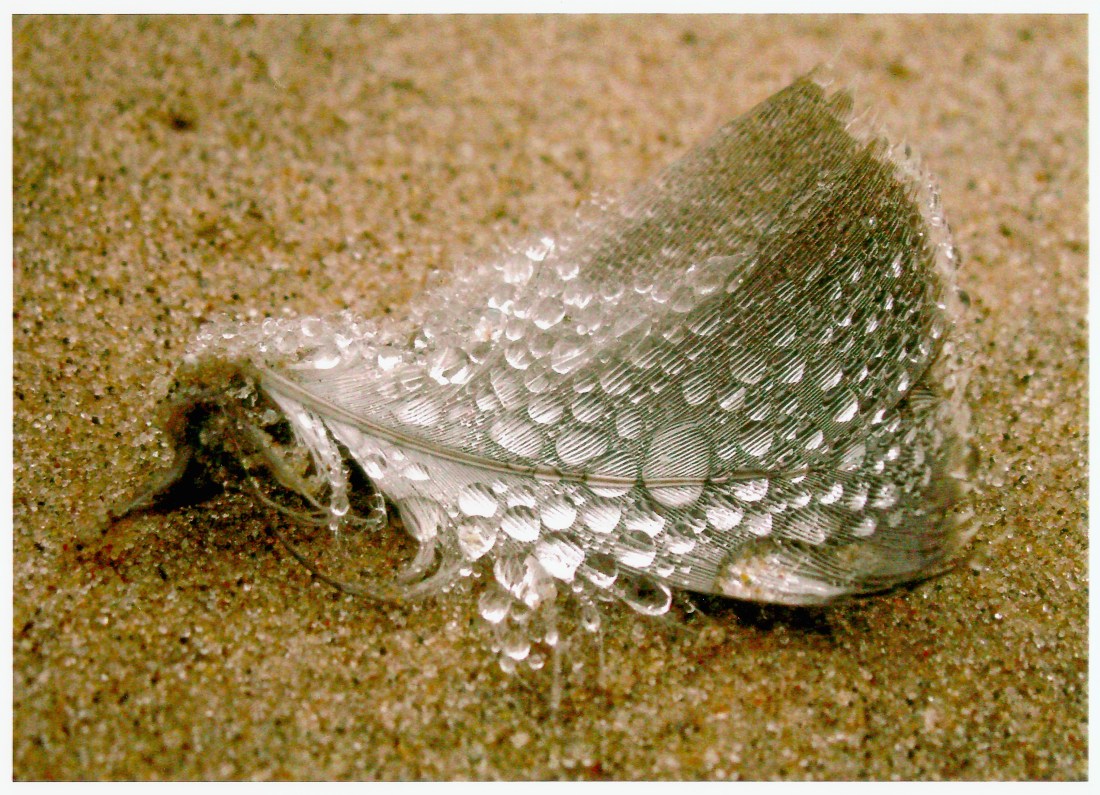
The feather took me a little more work. We have this photograph of a feather on the beach in Manistee, Michigan hanging on our bedroom wall. I see it everyday. Neil, the son of our college roommate captured it one winter some years back. Laying there, on the sand, covered in the moisture of the lakeshore, looking so incredibly delicate, separated from some lake bird, left on the beach, or perhaps washed up from a recent preening, maybe this is where the image of the feather entered my subconscious. Of course, I became curious about the nature of feathers, and the Internet did not disappoint me with a range of articles. I learned of plumology, the study of feathers. The earliest feathers were associated with dinosaurs, some three hundred million years ago. Feathers have a range of purposes, from waterproofing, to flight, and thermal insulation. Humans use these latter feathers, the downy feathers, for warmth as well, our down jackets, and down sleeping bags. Finally, feathers are among the most complex integumentary (related to the skin) structures found in vertebrates.
And then I thought of the attributes of feathers that I most identified with myself. Feathers are strong, resilient, and self-healing. Feathers are soft, warm, and delicate. Feathers can be decorative, both for birds, as well as humans. Lastly, feathers are replaced periodically through molting. I don’t think I identify so much with the decorative qualities. But, as I look at the list above, I can see my wilderness journey through depression. These depressive episodes that I have from time to time have often been a time of molting, of shedding what has failed to work out, shedding of personal failures, of shedding what weighs me down or holds me back. In depression, I find my strength and fragility, reclaiming resilience, and seeking self-healing.
Finding the phrase first: Feather in the Wilderness. And then finding the deeper meaning, the deeper truth, that has led me to writing these brief reflections that I can share with you. The practice of writing, an online journal of sorts, has some self-healing qualities, I think. These aren’t going to be my innermost thoughts, the ones that I will always hold close to myself, rather they are the ones that I have dwelled with for the longest time. They are the most complete thoughts, probably part of my nature to do my work internally, and not revealing it until I’m finished.
This is a blog of finished steps, on a journey to I don’t really know yet. From a phrase to a brief article, all steps on what I hope will be healing for me, and thought-provoking and entertaining for you.

 Sailing is my summertime self-care, and it’s put away for the winter. Covered in canvas tarps, soaked by the falling rain at the very end of the day.
 This past week, I’ve been plagued by insomnia. I get to sleep well, but sometime in the night, around two or three in the morning, I’m wide awake. And it’s eyes open, wide awake. Relaxation techniques – empty my mind – oh, crap, why am I thinking of that? – now, I’m thinking of that, too…..
 Feather in the Wilderness