Spock or Kirk

I haven’t been focusing a lot of attention on the Senate confirmation hearing, but I’ve seen the memes and listened to friends discuss it. I’m finding it all very troubling.

Leonard Nimoy And William Shatner In 'Star Trek'
CBS/Getty Images Copyright 1969 CBS

Mr. Spock, as you will remember, comes off as a cold analytical person, devoid of human emotion. Of course, we know that he is a hybrid: Vulcan on his father’s side, and human from his mother. In Spock, we see how he stuffs his emotions down deeper than anyone, essentially at war with his human half. He tries to live exclusively in his deep-thought half. This is the stereotype reinforced by the utter nonsense of ‘Big boys don’t cry.’ We see it again in the comments about Judge Kavanaugh, his emotional outburst makes him unfit to serve on the Supreme Court. This poses the question: Do we want the Supreme Court made up of nine Spocks? You can see how that would play out. Cases determined solely on the basis of reason and logic. When the facts are contradictory, or the evidence is absent, what decisions will be made? Perhaps it will be the strict ‘letter of the law’, or perhaps the case is remanded to the lower court. No intuition. No emotion. Perhaps the raised eyebrow, ‘That is illogical.’

We use different words to describe a woman that behaves as Spock: Cold, bitch, icy, bossy, angry.

I started writing this essay a couple of weeks back, and shelved it – unfinished – until I could coherently express myself. Until I had a language to clearly convey what is troubling me about my observations of the public political theatre. Part of this can be described as ‘toxic masculinity.’ As I write the phrase, I rail against the implied gender binary. Yet, in the society, the culture, that we collectively create and accept, gender binary is rigidly enforced.

I’ll leave you to ‘google’ toxic masculinity and all of its expressions while I focus on the limits imposed upon male identifying persons.

Anger. Probably the only cultural acceptable emotional expression for men in the toxic masculinity of our society. I doubt I need to point that out to you. I see it expressed in myself, all to often in my response to road-raging drivers, whether on my bicycle or in the car. Marcia is usually the one to point out my anger response, and I rationally know that it is a pointless response. Male rage is blind to anyone else. Any anger that I express towards the male rage is pointless for me, and only serves to increase the rage in the other man.

The other binder of male emotions is on hugging or crying. Perfectly acceptable in some other cultures, here we limit the expression to the field of sport. You’ve seen it, I know you have. And outside of sport is where the homophobic and denigrating phrases are used when it is viewed.

So I carefully choose the places where I can be truly authentic. General public, or the workplace? No. Constrained and restrained. Close loved ones, or church, or with church people? I usually feel safe.

I was at an annual gathering of United Church of Christ folk from all over Michigan this past weekend. After I gathered my lunch, and scanned the social hall for a place to sit, seeing that there’s a friend but the table is full, or there’s a spot at a table but I don’t know anyone there, I went with a comfort zone of mine – finding someone by themselves and asking, ‘Do you prefer to be by yourself, or may I join you?’ We introduced ourselves and chatted about the event until we were joined by another pastor that I know. Lunch continuing until she noted the semicolon tattoo on his right wrist. https://projectsemicolon.com/ Our conversation turned to depression and suicide, about Greg’s family, and as the attention then shifted to me, my response was silent tears. I said I was okay, and asked if I could pass. She revealed that her brother had died from depression and spoke of how her family continues to try to make sense of it. I shared that I could really understand the despair her brother was in, and I am working hard to change myself to be better capable to cope with my depression, and the occasional intrusive thought that I can’t suffer through another moment. As I dabbed my eyes with a tissue, in preparation to go to the next item on the agenda, I thanked her for making it a safe place, and my hope that her family’s grief would lessen in time.

We have to tear down this culture of toxic masculinity, because it is hurting and harming everyone, because it is killing, in part or in whole, each person. Life isn’t a game, and there are no sidelines.
To paraphrase what was said during my formative years: If you aren’t going to be, or aren’t a part of the solution – YOU are the problem.

(It occurs to me that I haven’t mentioned Kirk, his emotions expressed, his intuitive qualities that I can appreciate. Perhaps I have problems with his toxic masculinity, his bedding of way too many scantily clad women. You can strike the perhaps.)
Only Yes Means Yes

Trigger warning and language advisory

IMG_2476Last week I followed the national news too closely, and spent too much time on social media. #metoo is a powerful movement. I think it has changed men and women from victims or survivors into advocates for one another. In my utopian fantasy world of the future, #metoo becomes unnecessary as no one would even consider sexually assaulting another person. I was unprepared for the moving stories of #whyididntreport Those stories are compelling, and I won’t be looking at them again anytime soon.

I live in this world. Where people will question how someone can recall an event from the past with such clarity. Where people will question why someone would not report a sexual assault. Where people wonder why it took so long to come forward. Where people question the motives for bringing it forward now.

As for clarity, the memories are replayed over and over and over, seared into the memory with the pain of a branding iron. Details that the un-traumatized quickly forget are remembered years and years later. Locations, smells, taste, sounds, textures and where you were touched are not forgotten. This is not conjecture.

As for not reporting, there are so many reasons: Who do I report to? Does what happened constitute assault? Will anyone believe me? What if there’s no evidence? Fear of retaliation. Did I provoke it? Does not saying no mean yes?

As for waiting so long, I can stuff things down for a very long time, and I imagine that most anyone can stuff things down, almost out of reach, almost out of memory, until some thing traumatic happens, or a name comes up.

Twenty five years, a cinch. Indeed, over forty years.

I don’t remember the year, but I know it was October. I remember her grabbing my hand and running down the beach at night and then high into the dune. The taste of cigarettes and booze in her mouth. Her hand fumbling and rummaging around in my pants. My secret gratitude that others came down the beach and broke off the momentum. What the fuck just happened? Did I want that? Does she fancy me? I don’t even know this girl.

Was it a dare, or just drunkenness? We’ll never know. I didn’t report it. I didn’t know to report it. It pales in comparison to what others have experienced. I don’t know what her issues were.

I believe someone that comes forward years after an ‘incident’. It’s painful to reveal something that you have tried to hide for years.

Perhaps you can be so drunk that you can’t remember what you did. This wasn’t a car crash with parts spread all over the road. There won’t be justice here. There won’t be forgiveness here. There won’t be mercy here.

I am probably naive. I can imagine a world without sexual assault. I can imagine a world with justice, forgiveness, and mercy. It can happen.

It begins here.


More Questions than Answers

kisscc0-fractal-question-mark-shape-pri...5f16bdb0b93.0971889015344561718972There’s a podcast that I occasionally listen to called: ‘More Questions than Answers’ I found it because the phrase was in my mind, I searched for the phrase and I was intrigued by the title. It bills itself as a paranormal quiz show, with a Brit as the host and chief questioner, and two Minnesotan woman (doncha’ know). It’s trivia night with ghosts and hauntings.

I’ve been thinking about what I know (call them answers) and all the things that I’m curious about (questions). The question pile is certainly larger, especially when you toss some of answers into the discard pile because it’s knowledge no longer needed. Like bulk erasers (to erase audio tapes en masse) or being able to edit audio tape with a razor blade. The half-life of knowledge is so much shorter these days. Dial-up telephone modems? Shortwave radio?

Remember being in school? Teachers and professors would ask, ‘Do you have any questions?’ I had so many questions, seldom on the topic at hand, but questions that I would search for the answers of the moment.

Questions.

What is the meaning of life? Why are we here? Are we alone in the universe? What is my purpose? Where did our universe come from? What existed before the universe began? Where does love come from? Why does love go away? Why do terrible things happen to good people? Am I going to survive this? Will I survive the next time? When will I be able to move on? Will the grief last forever? How did this happen? How did this jerk get elected? Why aren’t people more caring? Why am I so hard on myself? Do you understand me? Do mean people even know that they are mean? Is there a fine line between self-care and selfishness? Will I be able to sleep tonight? Will I live through this night?

So many questions.

If you’re a parent, you remember the ‘Why?’ phase during toddler-hood. I am not sure I ever grew out of that phase.

So I have a question for you: What question are you asking yourself over and over? Would you share it with me?

I remember

That morning is still clear in my memory. Our oldest son delivered to Everett, and the youngest to Gardner. Stealing a few quiet moments with Marcia before getting to work late. Looking up to an amazingly clear blue sky and thinking, ‘Wow!’

An uneventful bike ride to work, and sitting in my office with the door closed after changing into work clothes from bike clothes. Making the rounds of checking email, equipment and servers, catching snippets of news as I passed through control rooms. Two planes crashed into the World Trade Center, not much is known as yet. ‘That doesn’t seem even possible,’ my internal thoughts. Walking to the front office to get the morning mail, Cindy snags me and says, ‘The towers fell.’ There, in her office, on a small TV was an image of a dust cloud over Manhattan, and then a replay of the second plane to crash into the towers.

I went back to my office stunned. I sent a brief email to my friend, Jim, who lives in Brooklyn but works in studios in Manhattan, ‘I hope you’re okay.’ A few minutes later, ‘I’m fine, still at home. What do we do?’ ‘Give blood,’ was my reply. I don’t know what I did the rest of the day other than keeping to myself. Probably had lunch with Marcia, probably did little things in my office, perhaps a visit to the transmitters, all these things a way to avoid interacting with others and experiencing their grief on top of my own.

I remember very clearly riding my bike up the driveway and seeing the vivid blue sky, unmarked by contrails. The unusual quiet, much like a campus building during a power failure, caused by the ‘ground stop’ of all aircraft. It was like a sanctuary. Because it was and is a sanctuary.

IMG_2258

In the early days that followed, the world responding, ‘We are all Americans.’ The gentleness that I felt from store clerks to close friends: ‘I’m glad you are here, because we now know how quickly life can change,’ the unspoken thoughts.

The days that followed were of rescue and recovery. I was seeing a spiritual healer because I was still reeling and coping with my brain aneurysm a year previous, and a cancer diagnosis just five months before 9/11. I remember thinking that I was that person that got up especially early, making the coffee in the pre-dawn darkness. Sitting quietly, with a freshly-brewed cup of coffee, watching the sky slowly lighten, waiting for the rest of the family to awaken. As each person woke up, and saw how incredibly fragile our lives are, deeply caring for the person they just met, the world was changed.

It takes a special kind of courage to live in that thin place. It is painful. If ‘getting stuff done’ is your thing, you simply cannot stay there. When you’re sensitive like myself, the feelings are overwhelming.

In minutes, lives were snuffed out. And almost as quickly, the care and concern we all shared was snuffed out in favor of revenge and retaliation. It’s been said that only five percent of Americans were opposed to going to war to avenge the terrorist attacks (I think my circle of friends were all in the five percent). We knew that there was no winning a war on terror, except by putting our swords back in their place. We had the example of a man that knew this saying, ‘…all that take up the sword will perish by the sword.’ They said we had to project force, that that was all ‘they’ would understand. Forgetting that wisdom is in not reacting, but by staying calm. Only one. Only one member of Congress had the courage to stand up to the drumbeat of war: Representative Barbara Lee of the 9th district of California (now the 13th district).

She made a choice. We all made choices in the days following 9/11 to care for those close to us, and the strangers in our midst. It was our choice. The drumbeats of fear and retaliation are so loud. We as a country have chosen to march to that beat. Individually, we can choose differently. Being peaceful, caring and loving will not make it on TV or on Facebook. But it’s the most courageous thing we can do.

Julian of Norwich, 14th century mystic, had amazing confidence. In the midst of plague, she said: “All shall be well, and all shall be well, and all manner of thing shall be well.” Collectively, the world in which all of the people we love, and everything we love, is in the midst of a plague of fear, we can choose to be courageous bringers of peace and love. (I have to keep reciting Julian’s words because it’s far too easy for me to see how unwell things are, and not the truth that all shall be well).

Labor Day

Labor Day always brings back memories. When I was school-aged, it marked the end of summer and the return to school. In all of the excitement and the slow process of organization of the new school year, those of us with birthdays in early September were overlooked. I’m certain that those with summer birthdays were also forgotten. Occasionally, my birthday was the first day of school.
That always felt awkward to me.

Another memory is the story that was always told to me around my birthday. Labor Day 1959 was a typically hot day, and my Mom was very pregnant. Mom and Dad packed up the family and went to an A&W drive-in, and during that meal I announced my imminent arrival. Her waters had broke. To complete the story, I was born early the next day into a family of siblings who had promised to leave home if I wasn’t a girl, or wasn’t a boy. They didn’t follow through on that.

Later on, in college, Labor Day meant working on Labor Day in Detroit. The Montreux-Detroit Jazz Festival was in its infancy, and the jazz radio station I worked for started recording and later broadcasting the festival. Hart Plaza was fairly new at that time. Early on, the station rented an RV and converted into a recording control room. Parked next to the dumpsters where the kitchens dumped their waste was unpleasant to say the least. It was a loading dock area, so it was four feet from the level of the main stage to the pavement, and we ‘borrowed’ bread and milk crates to build what passed for stairs. You used the stairs, or you walked way to the end of the loading dock around a concrete barrier and back to the ‘truck’. Those stairs became very slick with spilled oil and the inevitable rain that fell each year in Detroit. Later, the station rented office trailers that were out of the ‘garbage zone’ and had a good view of the crowds of people.IMG_1145

Initially, the broadcasts were local. Equalized phone lines from Hart Plaza to WDET, and then, over the air to WEMU. I remember one year, after sweeping the lines (test tones to be certain that the quality was what was paid for) and finding them unacceptable, we had a conference call with phone technicians at every amplifier and equalizer in the run to WDET and with WDET’s engineer. We did our best to get them right, right up to the seconds before air – literally, we were in the minute before the broadcast before we had to stop and start the program. Another hour or so would have helped, but that was all that could be done. It was Friday morning, and there would be no technicians available until the Tuesday after Labor Day.

As time went on, things became more complex. Two recording control rooms each feeding hundreds to thousands of feet of wire, with intercom and video feeds back to a central broadcast control room that received a sub-mix of the broadcast hosts from yet another location. My responsibility was to make sure everything worked right, and fix it if it didn’t. As Friday before Labor Day wore on, there was always anxiety went the stage lighting was turned on. What new problems would be discovered with buzz and hums from the lighting? Soon, the broadcasts became national broadcasts with an NPR satellite truck brought in. This meant another long set of audio and intercom cables.

These became long days, where I’d take vacation from my day job back in East Lansing, pack up tools and borrowed equipment, and live in Detroit from Thursday to Tuesday. Early in the festival, the days started on-site at eight in the morning, and not leaving the site until midnight. A club sandwich and a glass of wine, or a bottle of beer, a quick shower and collapsing into bed until room service woke us at seven the next morning. There was more free time later on when the to-do list was shorter, and occasionally I’d be asked to record a set or two. Fifteen and sixteen hour workdays did take its toll.

There was one memorable year that I worked live broadcasts from the Michigan Festival, including two or three live musical broadcasts in early August. Back to the regular day job of being a broadcast engineer (all of which was in catch-up mode), and then into the Jazz festival. That was the year it all caught up with me. Too much work, not enough recovery time, and other issues pushed me over the brink. I had to ask a friend to take away my set of keys to the roof of my building because I could no longer feel safe having them. It was when I first understood that I had to take care of myself, to say ‘no’. A lesson that I need to repeat time and again.

So, I well remember the exhaustion, but it is tempered with the knowledge of work well done. Many hours of live broadcasts sent into space and back. Many live tracks on CD’s and vinyl for the jazz musicians. A deeper understanding that beyond sleep and rest, I have to have time to reflect, ponder and be quiet, sometimes by myself, to be able to sustain the me that I am, or else.

This is what comes to mind each year during the Labor Day week. The Michigan Festival is no more, and the live jazz broadcasts ended to 2001 or 2002. I do miss the annual reunions in Detroit with the crew from Aerial, with Jim and Dave. The little espresso machine tucked in by the monitor mix position. Cutting off screws to door (breaking and entering) to get access to where the hosts would broadcast from because the overnight security person took the keys home with him. The year I got a late night call from the satellite uplink engineer that slid off the road in heavy rain and getting a fly-pack uplink flown from DC to Detroit in time for the broadcast. Basically, a year of problems packed into a few days. I miss the people but the long days, not so much.

Vacationing in Retirement

“You’re retired, why would you need a vacation?”

Because you can gather with your logical family, and get away from home and all of the home chores, and go to a cottage and do cottage chores.

IMG_1836While we worked every day, we made sure not to work the whole day. There was one excursion to our sailboat for pure pleasure. There was laughter, a trip to a restaurant, and more than one trip to the pub. Oh, and a trip to the dump.
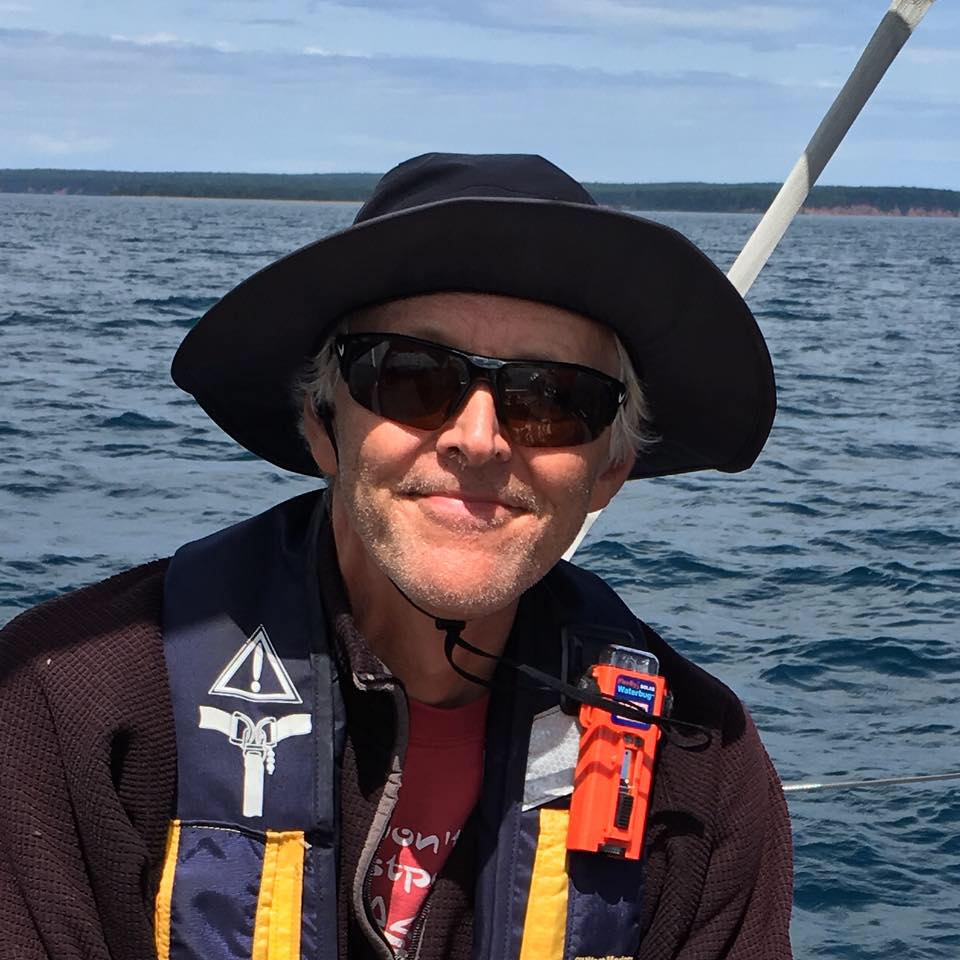
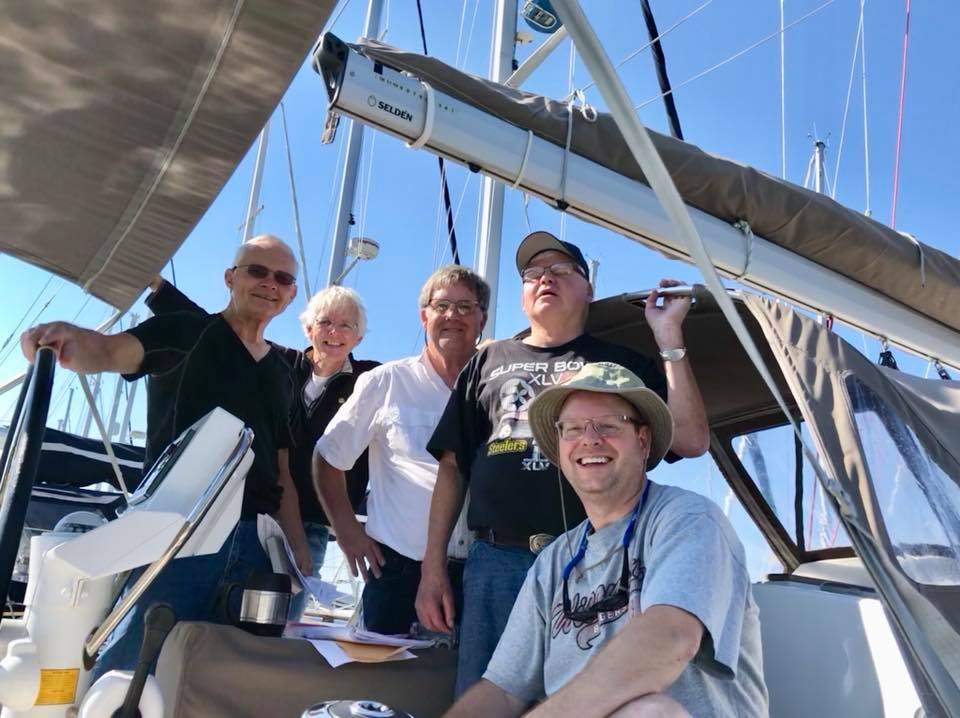
I did take a break from writing, but I finished two books.

The first one I finished was “Swell’ by Liz Clark. She’s a young woman who graduated with a degree in environment studies from UC Santa Barbara. She’s an avid surfer. A professor friend wanted to assist her dream in sailing around the world and offered his sailboat. When the boat proved to be too small for the voyage, he helped her buy a boat – a Cal 40. He lived vicariously though her emails and phone calls. While her story included the inevitable tales of boat repair in exotic locations, it wasn’t really about the boat. It was about her growth as a woman, the sexist culture in the Pacific Islands, and a developing sense of confidence as a skipper. She learned she could do just about anything, and she learned how one egotistical, jealous lover could just about destroy everything. There’s a lot I don’t know about surfing, like everything really. I recommend the book as it describes the true power of a mentor facilitating someone’s dreams. In the ten years or so of her journey (spoiler – she doesn’t complete a circumnavigation), she becomes a rather amazing person and a great storyteller.

The second book was ‘The Living Great Lakes’ by Jerry Dennis. He tells the tales of the five Great Lakes while weaving in a story of signing on as crew to ferry a ferro-cement (yes, a concrete boat) from Traverse City to Maine. It’s an older book, but still a very interesting read for anyone that has fallen in love with these Great Lakes.

So as I sit here in a recliner, looking out at a foggy Lake Michigan, on the last day of the working and playing vacation, with still another day to play upon our sailboat before going home, Bell’s Oberon at my side, I bid you all the happiness you can stand.

Oh, I should mention that there’s a new URL for this blog: featherinthewilderness.com I decided that I really enjoy these reflections that I write, and the title.

Causes

Facebook reminded me that my birthday was a month away and wouldn’t I like to raise money for a cause that was important to me. Gut reaction was: I wonder how big a cut Facebook takes from the donations? Since then I have been pondering: what causes are important to me?

IMG_1895

Mental health is really important to me. Having cycled through deep depression a few times, I wish this was a cause that you could raise money for and resolve it. I’ve written before about how you can help when people you care about are in depression. Mostly, what I think you should do is to put the National Suicide Prevention Lifeline phone number as a contact in your phone, and share that contact with others. If being able to call the hotline by asking Siri or another digital assistant makes a difference, and I think it might, please add them: (800) 273-8255 Hey, Siri, call the National Suicide Presentation Lifeline… Makes sense, right?

Comprehensive sexuality education is a volunteer activity that I have found rewarding for the past twenty years. I work mainly with high schoolers and giving my time and accurate information has made a difference in their lives as well as mine. You could donate money to the United Church of Christ or the Unitarian Universalist Association to support Our Whole Lives, or better yet, if you feel so called to serve, volunteer to be a facilitator in your UUA or UCC congregation.

I really enjoy bicycling, and I’ve really found bike lanes and bike paths make our neighborhoods better places to live. You can support that by joining the League of American Bicyclists, vote for millages that expand bicycling infrastructure, or riding your bike. What I really wish is that people wouldn’t use their mobile phones while driving, and pay attention to us vulnerable users of the roads we use in common. If you want to get a sense of what it feels like to be passed by a motorist at speed, stand on a curb along a roadway where the speed limit is 45 mph or higher. Does it make you nervous? Is it better when the motorist is driving slower or a full lane away? If it is safe for you, slow down and give a lane to the bikes. You might get a mental gold star from the bicyclist you pass.

Maybe the cause that I’d really like to see is that people would be kind. I know that I’m not always kind. Usually, I feel badly when I’m not as kind as I could be, and I try to do better. I know I get bothered when people that drive act like they’re the only ones on the road. Or I might reply to an email without giving more thought to my words.

So perhaps that’s my cause. Be kind to one another. No great sums of money need to be raised. Make space for cars to merge on the highway, even the ones that blow past and cut in at the last second. Let that angry email go, and don’t reply, or certainly don’t reply right away. Take a walk to pick up trash. Smile. Show your love.

I am a good man

I like bicycling by myself. I like bicycling with others, too. But lately, what I have observed is how bicycling occupies part of my mind. That part focuses on potholes and pedestrians, bicycles, bollards and broken glass. I guess it’s then when my subconscious can sneak phrases of truth to the higher levels.

It was during one bicycle trip a few months ago to see David, my therapist. Somewhere along the River Trail the phrase “I think I’m going to make it” bubbled up. Later on, during my session as I was describing how I was feeling, there it was again. I think I’m going to make it.

37849273_10217205393586288_3827080817268490240_n

During these depressive phases that I go through, it seems that the part of my brain that focuses on road hazards is focused on my foibles and failures. Every way that I am not the kind of person I want to be grows into dense layer that holds me away from life itself.

I am a good man. People will tell me that from time to time. Depression brain usually replies with a one-syllable utterance, or at best, ‘I try.’ In the glass half-empty, or maybe more accurately a cracked glass, the phrase slips through quickly and is gone.

And then last week, bicycling to therapy, I was surprised when I had this thought: ‘I am a good man.’ (This is not a way to seek your affirmations – rather, it’s my self-affirmation that is most important) I have not felt that I was good for a long time and it’s taken some months of time and therapy to get back there.

And last week, sometime into my session with David, I said, ”I am a good man.” “I am so glad to hear you say that,” said David, “because you are.”

I think I am going to make it. I am a good man. I wonder what subconscious phrase will bubble up on my bicycle ride today.

Introducing

Think back to the last time you introduced yourself to a new person.

What did you say?

What was the first thing you said? Likely, it was your name, how you wished to be addressed. And then what? At church, it’s usually my pronouns. In other settings, among males, it’s occupation, or former occupation. And then what? Location, where you live. And then what?

38033544_10160867649490790_7615032180367949824_n

Often from there, it’s family structure: married or not, children or not, and so on.

When do you get into the real stuff? The really real stuff. The times you succeeded, or the times you failed? The experiences that have shaped your life. The people that you’ve loved and lost, the people that passed through your life and changed you for good.

The intersectionality of all of the ‘yous’ that you are, each part identifies and differentiates. Those parts you claim, and those parts that others chose to call you.

What more do I say?

Do I mention that… …that dark shadow that sometimes overwhelms me.

Do I mention that… …at times, I have simply wanted to be done with life.

Do I mention that… …death doesn’t scare me, because I’ve seen worse.

Do I mention that… …I think there are some things beyond our comprehension, and I don’t think it’s the common definition of God.

Do I mention that…

Do I mention that…

Do I mention that…

More On the Brink

I’ve been reading Parker Palmer new book: ON the BRINK of EVERYTHING.

I read it slowly, savoring every paragraph, reflecting on it every few pages.

You remember I have depression, and now, a few months into feeling good, I can see when this latest episode got started. It was a full five years before I sought treatment in March of 2017. One of my goals is to catch it earlier next time, as there is likely to be a next time. I’m okay with that. I’ll probably stay on meds now, and I’m okay with that, too.

Two paragraphs from Palmer’s book has resonated with me, and I’ll share them with you now.

“Even the most devastating experience can be a doorway to contemplation. At least, that’s been true for me in the wake of my depressions. While you are down there, reality disappears. Everything is illusion foisted on you by the self-destructive “voice of depression,” the voice that keeps telling you you are a waste of space, the world is a torture chamber, and nothing short of death can give you peace. But as you emerge, problems become manageable again, and everyday realities—a crimson glow on the horizon, a friend’s love, a stranger’s kindness, another precious day of life—present themselves as the treasures they truly are.”

IMG_2176

“I’m a “contemplative by catastrophe.” My wake-up calls generally come after the wreck has happened and I’m trying to dig my way out of the debris. I do not recommend this path as a conscious choice. But if you, dear reader, have a story similar to mine, I come as the bearer of glad tidings. Catastrophe, too, can be a contemplative path, pitches and perilous as it may be.”

Next time, I’ll catch it sooner. In the meantime, I’ll accept everyday realities as the treasures they truly are.

Peace to you.