The Ends

I have been thinking about the end lately. I believe that it comes from the end of the school year at our neighborhood elementary, the friend that is facing the end of his job, and the end of a friendship.

Philosophically, I know that if things have no end, there would be no time or space for something new. That in almost every end, there’s a new beginning.

IMG_2096The end of the school year is the beginning of summer vacation. The end of a job is the start of retirement, or the start of a job search. The end of a friendship is…. I’m not sure. I look back at friendships that I have had that have ended and they have almost always ended by drifting away, a fade-out. (I leave out the ones that have ended by the death of a friend). Deliberately ending a friendship is something with I don’t have a lot of experience, and something that I probably avoid at all costs. In the end, I wrote a letter, and didn’t send it. It turned out, in the end, not to be necessary. It was a kind and true letter, it stated how I felt (always using ‘I’ statements), expressed what was good, and what wasn’t, and why I felt there was nothing good left for me.

True, kind, necessary. A device attributed to the Buddha, to Socrates, and probably others. For myself, what I wrote met all three. The writing provided a clarity for myself alone. For the other person, I’m not certain. What will happen to this friendship will be a further fading out, for me more purposeful. I feel a bit sad that it will end without the clarity of what I wrote. I suppose there’s always a possibility that it’s a break, and not the end. I have no way of knowing.

Second blog post in a row about friends. It tells you something about my friendships, surely.

So, my friend, would you please do something for me? Get out your mobile phone and enter this contact: National Suicide Prevention Hotline 800-273-8255 Share it with your friends. I hope you don’t need it, just like I hope if you have first aid or CPR training you never need to use it. Ripple that contact out there.

Shalom,
Harold

(oh, and hey fellow ponderers: Why is it that ropes have ends, and never a beginning?)


All the hard work pays off

The off-season was challenging. Arcturus went to bed in the fall, it’s mast horizontal, stripped of all the running rigging, standing rigging, spreaders and internal wiring. As winter approached, I took a circular saw to a bulkhead by the mast and cut out a large panel that was partially rotted. Stuff was everywhere. The dining table was stuffed in the V-berth, along with the spinnaker pole and boom.
The deck that the potty sat on was no longer fit for purpose, so it came out. I trimmed a roughly sized piece of half inch plywood to temporarily replace the rotten bulkhead. Sawdust and shavings, dirt, tools and everything else that needed to move somewhere else, the hill seemed too steep to climb, the tasks certainly larger than my ability to cope, I cried. Sitting on the sole in the main cabin, I couldn’t see the end, was uncertain if it could ever come, my spirit was crushed.

Steadily, in the darkest days of winter, lists and checklists were made, materials ordered. Refitting was stymied by cold and colder weather. Sometime in early Spring, I drove out to the boat, removed the temporary bulkhead and jammed a support into place. On a dry day, we went to the lumber yard that stocked the pricey teak veneer plywood. Soon after, I was sawing that expensive plywood to fit. ‘Don’t mess up,’ I thought, ‘this is $175 a sheet.’

Seemingly, everything took longer, cost more, required more work and more energy. The to-do list got longer the more that we worked. It was hard, and not very encouraging. Tiny little gains, and huge disappointments.

IMG_1661

And then, Arcturus is in the water, and soon it’s a beautiful sight, making 6.3 knots on the smooth water of Lake Michigan. The payoff.

And, of course, this is a reality, and an analogy.

Three months ago, I started this writing and illustrating project, this blog: Feather in the Wilderness, and it has been wonderfully healing for me. Each week, I’m paying attention to what I’m feeling, keenly observing and distilling it into a few words and a few photos. Nearly four weeks ago, like a switch, I felt good. Like being put into the water that I belong after months – no, years – of being in a parking lot. I’ve been working through this depression that I have had for a long time, making tiny little gains, and having huge disappointments. More than once, there was no end in sight, uncertain that I would ever feel happy again. Depression is more than just feeling sad. It’s this spirit crushing disease that takes away the very will to keep going. Some of you understand this so well, others try to understand, and I thank you for your effort.

It’s a little moment, laying down on the fore deck, seeing the lovely curves of the sails, the blue sky, and the sound of the bow cutting through the water, when my life is restored.

When you know that someone you care about is going through the darkness of depression, won’t you take a moment, be honest if you know or don’t know what they’re going through, and give them that hug or high-five, you made it into another day, and you can do this hard thing. This hard thing of rebuilding your life while you are living it.

Thanks,
Harold


Friends

I’ve had an exchange of emails with a friend who lives in the UK, and the gist was how difficult it is to form friendships when you’re not on Facebook, not working, not in the bar or pub scene, not connected to a community. I gave that some thought and I think it would be really hard for me to form a friendship as an adult without a common interest like bicycling, sailing or singing.

IMG_1922Of course, me being me – I ruminated and thought about almost all of my friendships. Those I formed in elementary school and junior high, ones that stayed close on into our 30’s and 40’s and have slowly drifted apart. I understand why: living in different towns, children born in our middle and late 20’s grew to have activities of their own, and there just wasn’t time to keep the friendships going strong. I miss them, and I should make a better effort to reconnect.

There was a high school reunion for me last year, and it was really interesting to reconnect, and be Facebook friends after all those years. I’ve seen a couple of them since, so I think that’s good.

There’s the really close friends that we really make the effort to stay close, and the friendships that were only work-related The ones that formed at the Marina, and not being there anymore, they have drifted into reacquaintances. The friendships that crossed boundaries and aren’t able to continue except as awkward and uncomfortable experiences.

I have no idea what it would be like to not have friends. (excuse the double negative). I think it would be quite difficult and rather lonely. I am really grateful to have good friends, and I’m super grateful to be friends with one woman, Marcia, on into our thirty-eighth year together.

And to my UK friend, keep at it. You’ll form friendships soon, and in the meantime, know that I can be a good friend.

Are you okay?

This was the question that Kevin Hines so desperately wanted to hear from a passerby on the Golden Gate Bridge before he listened to the voice, ‘Jump Now!’ Over the four foot railing, one second of free fall, and into the chilly waters of the bay.

Kevin Hines, a man who has bi-polar depression, and suicidal thoughts almost every day, was nineteen years old that day on the bridge. He’s the central figure in a new documentary, ‘Suicide: The Ripple Effect’, that Marcia and I viewed in Ann Arbor last week.

The opening scenes takes us out on a boat, under the bridge, with Kevin and the now-retired Coast Guard crew member that had pulled Kevin from the waters and onto the motor lifeboat.

13570337_10208860533447272_587728632_o

This is the beginning of the ripple effect, the toll carried by the ‘Coastie’ serving at Coast Guard Station Golden Gate, who recovered 57 bodies and rescued one in his tour of duty. Kevin’s father, who is prepared, every time his phone rings, to this day, for the news that Kevin has died by suicide.

It sets off a chain reaction in my mind as I think of my friends: the wife who lost her husband, the son who cleaned up the mess his father left in the living room, the mother who will have perpetual grief from her daughter’s death. And the friend with a plan, but got sick instead. The friend whose anxiety crossing highway bridges, because of the thoughts, became my anxiety: Could I get there in time?
And yes, I think of those times where I…

The ripple effect. One person’s actions leading to another’s. Throughout the documentary, we also see the crisis counselor, the survivor, the parent whose work of helping one more person to stay, ripples outward.

It’s a lot to ask, really, wanting a passerby to ask, ‘Are you okay?’ Too much to ask? But for friends, not that much. And for yourself, ask your self, ‘Am I okay?’ Should the answer be something other than ‘Yes’ – there’s help: 1-800-273-8255 1-800-273-TALK. It’s okay to call anytime.

Every day, as part of my self-care, I ask myself: What am I feeling? Am I okay?

And I’ll ask you: Are you okay?

Rain

IMG_2064Sometimes, the rain doesn’t stop

In the middle of last week, I was biking to my periodic therapy session. A most amazing feeling came over me, one that left me both surprised and grateful. ‘I think I’m going to make it’, was my thought.
There were fleeting glimmers of that in the past, the thought quickly submersed by the continuing depression. This time, it was not snuffed out almost immediately. Instead, I sensed it taking root, and I will tend that little shoot of hope as if my life depends on it.

Marcia and I were driving home from way out East a week or so ago. She said, ‘I feel sad sometimes, but I always seem to know it’ll pass soon enough. I don’t think I ‘get’ depression.’ I thought for a bit and said: ‘It’s like when it’s raining, and you know the rain will stop. Depression feels like the rain won’t stop, and the river will rise, and before too long, you’re treading water. And if you can’t keep on treading water, and when you’re too tired to keep going, then all is lost.’

I know, for some, the rain just doesn’t stop. I don’t understand why that’s the case for some, and not for others. I’m not confident (right now) that the rain will always stop for me, and eventually, I’ll be safe, dry and warm. Thus far, the rain has stopped, and I’ve been placed back on the dry ground. Right now, for me, the flood waters are waist deep and the sky is lightening.

It’s Mental Health Awareness month again. You, my dear reader, know at least one person that has depression. Me. And I’m certain you know others, too. Living with depression is hard. Healing from depression is hard work. And there’s a bunch of other mental health issues that come with depression. Learn about them – use the Internet – http://www.nami.org is a start. Depression is not the only mental health issue that people live through, but it is the one that I know best.

Do you want to help someone with depression? Do you want to help me? This is what helps me get one day closer to health: Don’t make me do anything. Instead, invite me to: Go for a walk, or a bike ride. Go to the art museum. Take me out for a meal (preferably where they don’t serve alcohol, because alcohol is a depressant, and it screws with my meds). Go someplace quiet and watch. Sit with me in silence. Play some music. Watch a sunrise, or a sunset.

Don’t be dismayed if I turn you down. Turn you down, over and over. Be persistent, but not nagging. Don’t take it personally. Chances are, I’m doing the best I can. And since for me, this is not my first trip, I really do know what’s best for me. (But try to make sure I’m not doing something harmful.)

Don’t forget that sometimes I need to be by myself. Sometimes, I pull away. Limit the number of friends I’m in contact with, or limit the time spent, and that’s okay for me. Really.

Ask me if I’m sleeping okay. Ask me what I’ve been eating. Ask me what I’ve been listening to. And just listen when I start to speak. Only interrupt when you need to clarify.

These are my things. They work for me. They might work with others, too.

Thanks for reading my blog. The practice of writing and illustrating is helpful for me.


Commencement Exercises

FullSizeRender1

This is the season for graduations. I am amused that it’s called commencement, as if all of the work that went before came before the beginning. My friend, and former colleague, Nancy, called her retirement, commencement. That’s probably a healthy way to look your work life as a preamble to what comes next.

‘OK, what’s next?’ was what my oldest niece placed on her mortarboard for her commencement exercises. It’s a homage to the TV series ‘West Wing’ and the oft-said phrase by President Jeb Bartlet. It’s a good phrase for someone that has completed her nursing degree program and is looking forward to what comes next. And what comes next is more education, a continuous process in medicine, no matter what part you practice.

I think it’s interesting that we add the word ‘exercise’ to the commencement. I suppose exercise might refer to the fact that commencement recurs on a periodic basis, just like physical exercise is repeated again and again.

Commencement exercises reminds me that all that came before prepares you for now, and next. And that tomorrow we repeat the process, a new now, and a new next.

So, Congratulations to all the graduates! You worked hard, and for now, you’ve completed something. Tomorrow, there will be the next. And special congratulations to my niece, Tamar, and for all the new beginnings that come to you.

Living in the Meanwhile

IMG_1617There’s a poem that I keep coming back to. You have those days, I imagine. The to-do list keeps getting longer the more you things you tick off. The calendar balloons to fill those gaps that you left just for yourself. Where the unplanned writes over the planned. When it just all seems like too much.

That’s when I seek out my guide star. My guide star poem is Mary Oliver’s Wild Geese. I’ll share a link to it, as it just seems like infringement to share the poem here. http://gwenglish.blogspot.com/2014/04/poem-of-day-mary-olivers-wild-geese.html

The two opening lines reject the idea that you have to be good, or you need to repent.
The third line is truth: You only have to let the soft animal of your body love what it loves.

That’s all I have to do – to-do list be damned.

She then speaks to the mutual sharing of despair. When you’re sensitive like me, the world seems so cruel. The sharing of what pains you, or what pains me, lessens the pain.

And then Mary Oliver turns to the meanwhile. Meanwhile the world goes on.
Meanwhile the wild geese are heading home again.

And the last line:

Whoever you are, no matter how lonely,
the world offers itself to your imagination,
calls to you like the wild geese, harsh and exciting –
over and over announcing your place
in the family of things.

My mental addition after ‘no matter how lonely’, no matter how sad, no matter how depressed, no matter how glad, …announcing your place in the family of things.

Sensitive

IMG_1985

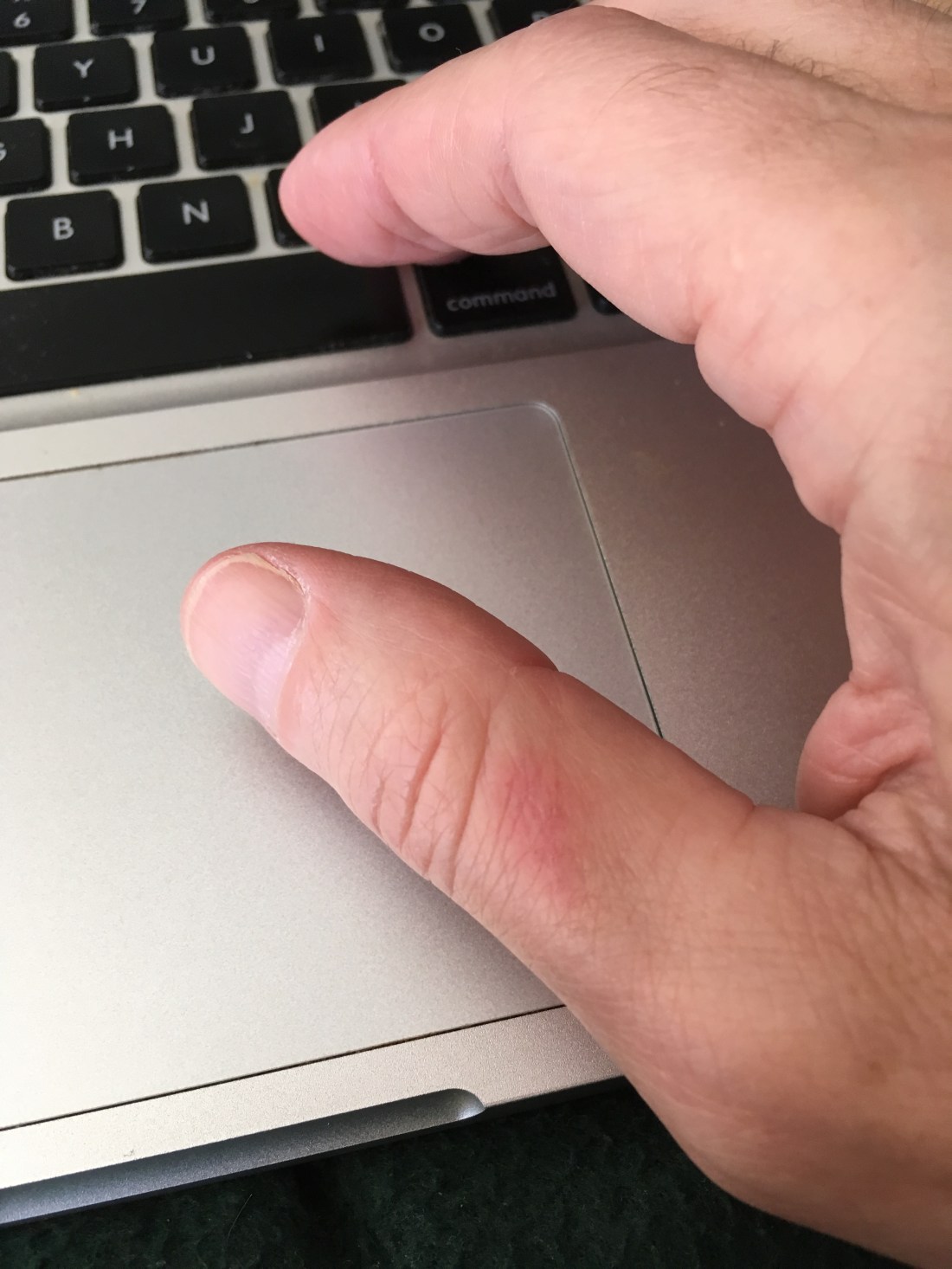
About three weeks ago, I burned my right thumb with a heat gun. I burned it near the knuckle, and at the time I did it, I thought it wasn’t so bad and kept working on my task. A few minutes later, I put my thumb into ice water and I wished I would have done that sooner. It was pretty clear to me that it was a second degree burn. Fortunately, I’m left-handed but I use both hands equally as well. It went from painful to very sensitive to ‘it still hurts’ and now it just feels weird.

Last week, I read an article that a friend from my former workplace. She wrote about how exhausting it was being with a lot of people, and mentioned her Myers-Briggs personality type. Now, I don’t need a test to know that I’m introverted, caring, kind, intelligent, observant with a side of detachment. I don’t need a test to know where my gifts are, nor where my weaknesses are. I completely identify that, for me, being with a large group of people is exhausting. Still, it got me thinking about the job that I retired from about five years ago, a job that I held since, and the job I held before.

I started my first job in broadcasting about forty years ago. For the most part it was fabulous. The hardest part was it was a full-time job that was really two part-time jobs glued together. My managers were awesome, Art Timko especially so. When you are treated as a human being, with care and trust, by someone that really wants the best for you even when it means letting you go – well, it doesn’t get better than that. And sadly, it never got better than that. That radio station was a family, who worked their butts off because of the support we received from Art and from each other. There was a free flow of communication. I didn’t know how special that place was until I left.

The next job was just one job, full-time, and it paid considerably more. And it was fine, at first. And there seemed to be a sense of community, for awhile anyway. But under the surface, there was deceit and distrust. The basic management style was to hold on to information, to manipulate, and those that worked their butts off were exploited until they finally learned that your effort meant little to those in charge. We went from lean and mean, to just plain mean. Don’t get me wrong, there were people that cared and supported each other, and I counted them as friends. They were my colleagues. Management, not so much.

I hung in there. I served on a mission and goals team, suggested improvements, and almost all of that work went unheeded. When my children were small, I was told that my first priority was to the station. But my first priority was to my family, and from there the internal conflict began.

There was my first major depressive episode that I sought treatment. It was brought on by that internal conflict, too much work, from broken trust and some other stuff I won’t talk about here. I stopped working for a few weeks while to get away from dangerous choices, and healed enough to go back. I had thought that this was situational depression, and if I quit and went somewhere else, I would not learn to cope and I’d probably bring it with me to the next job. People from work seemed, on a whole, to be a threat to my well-being. We didn’t want any contact from work until I was well enough to go back. I don’t know if that was disseminated from management to the rest of the staff, my suspicion (from the experience that managers used information as power) is that very little was shared. There were a few people that stayed in touch, not because they couldn’t follow ‘rules’ but because they cared a lot about me, and they knew the workplace wasn’t very healthy, and were highly sensitive to the dysfunctional situation.

I went back to work, wary and cautious. I mainly kept to myself, steeling myself before going in, focusing on my work, getting it done and getting away. I had just started graduate school, too, but that was fulfilling and enjoyable. Over time, the work budgets got even tighter, and people that retired were simply not replaced. This caused a lot of stress for me as it really meant I was on-call virtually all the time. I wanted to quit, but I stayed with it because my family needed my benefits and my earnings. I kept at it for another twenty years. Towards the end, I don’t think I was very kind or caring to my colleagues (sorry, my friends – I was in full-on survival mode).

What does this all have to do with a second degree burn? If I match up the burn with the major depression, then the recovery from each was painful, then very sensitive, to ‘it still hurts’. In a week or two from now, the burn I experienced will be gone except for a little discoloration. Twenty-five years on from that episode of major depression, I went through to ‘it just feels weird’ and back to somewhere around very sensitive or ‘it still hurts’. Maybe another year or so, it’ll get better. It’s really clear to me now that I trend towards depression when stressed or in conflict. The best thing for me is to move on, and let go. I know this, but what I really want to do is fix it.

If anyone from my former workplace is reading this, I feel badly that I was less than kind, or focused more on getting the job done and moving on to the next thing. You really have no idea what I was dealing with, or how painful it was to re-open a wound last year that was unhealed from 25 years ago.


Baby Feet

IMG_1971I’ve been walking in my neighborhood a lot lately. We have a miniature poodle that loves his walkies, and when it’s not pouring down rain, he usually is walked three times a day for a half hour or so.
I get bored if we take the same route every time, and he seems to enjoy the novelty of a new route.

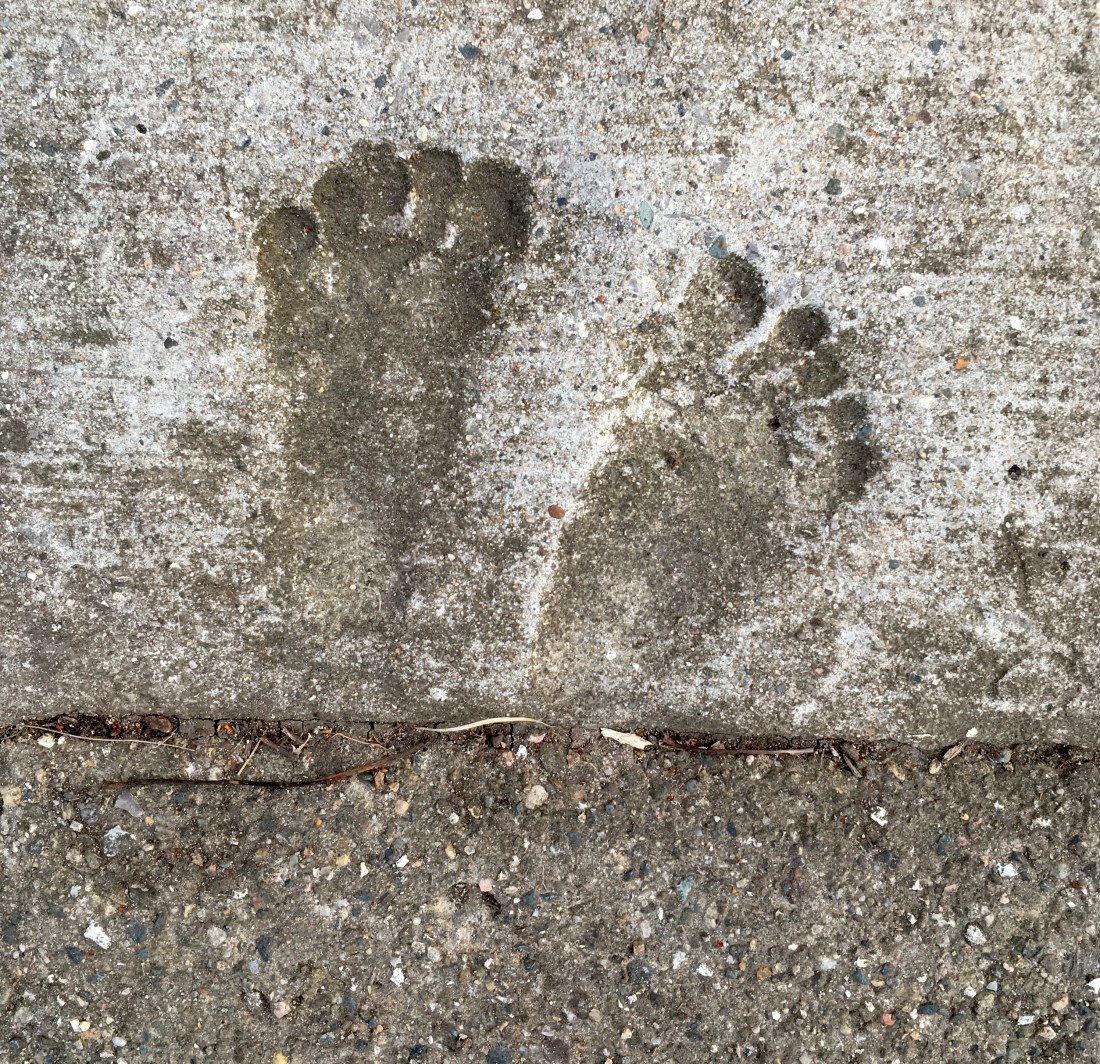
One route we take is along Cedarbrook, where I spotted a pair of baby footprints. There’s something about wanting to capture and make permanent a moment of time when our babies are small. We did the same thing, pressing our elementary school aged children’s feet into wet concrete. (Sadly, the section of concrete in our front walk was demolished when our lead water service line was replaced).

Every time I walk past these footprints, I find myself wondering about that child. Where are they now? What are they doing? What sort of childhood did they have? What issues did they overcome growing up? Have they graduated college yet? Are they happy? One thing our city requires is a stamp with the year, and the concrete firm’s name in the freshly placed concrete. Walking through the neighborhood, I get see a variety of dates, from fairly recent to older than I am. The concrete where the baby footprints are dated 1998. We’re twenty years on from then at this writing.

At the same time that I’m thinking about that anonymous baby’s feet being pressed into fresh concrete, I’m reflecting back on 1998. That was the year that I had a study abroad class in France, and we, as a family, spent 7 weeks overseas. That was the year when we spent a week in Cornwall, and where I found a sense of ‘homecoming’ in that land where I had never been, but was connected to through my grandfather, and his kin. That was the year where the World Cup was held in France, and France was victorious. That was the year where we saw what high security looked like: gendarmes with automatic rifles held at the ready when we entered France by ferry, teams of similarly armed soldiers in the Metro, on the streets. We rarely see our police forces armed like that, though we do see civilians armed with semi-automatic assault rifles playing at being a security force, but generally just terrorizing us unarmed folk.

What kind of a world have we created? Not a very good one, in my opinion. Those tiny feet, pressed into the cool, uncured, concrete. We’ve given you a country that has been at war for almost your entire life. We’ve given you a country where unarmed black men can be gunned down by police without justice. We’ve given you a country where sexual assault survivors are disbelieved, and perpetrators are protected. We’ve given you a massive mess that too few are trying to clean up. Anonymous baby of 1998, I’m sorry that the world, the country, the state, and this city is so broken. I sincerely hope you have the ability to fix all this.

Plumology

I’ve named this blog ‘Feather in the Wilderness’. I think I should have a profound backstory on the significance of feathers and the wilderness, some sort of lengthy thought process that led me to choosing this name from all the other possible names.

I have nothing of the sort. Early one Sunday morning, I woke up from a dream with a phrase on my mind: Feather in the Wilderness. I thought I should make a note of that phrase, like there could have been a deeper subconscious meaning. Later that Sunday afternoon, I googled the phrase to see if it had appeared in poetry, or anywhere else. I found it was pretty unique.

Then, I got to thinking about words in the phrase. Wilderness was easy. I had titled a sermon, ‘Into the Wilderness’, a few months before, and had just delivered it a few weeks before. Wilderness was a place that my church was exploring as we navigated the Lenten season and we delved into deep, difficult topics. My sermon was largely revealing just how dark my periods of depression have been, and how the church can work to de-stigmatize depression. The wilderness of depression, for me anyway, is this place where I lose my way, wander in the darkness, and feel like I’ll be lucky to make it out alive.

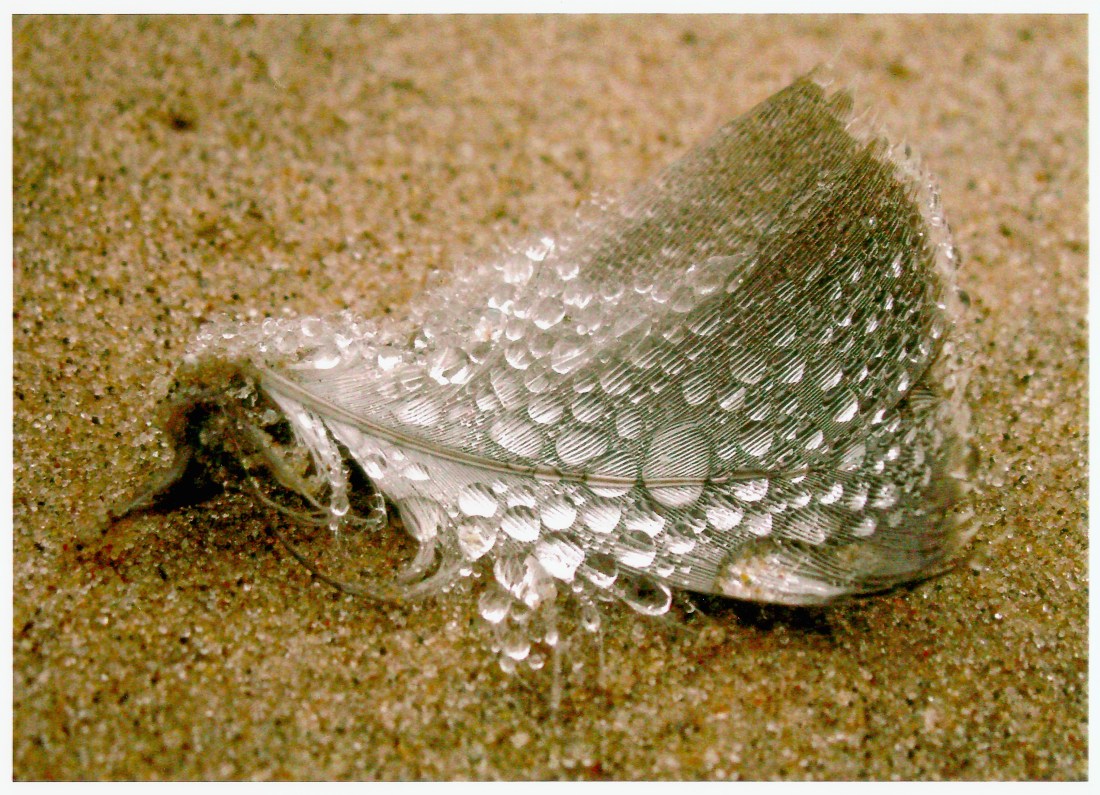
feather-ncf 2

Neil Cole-Filipiak, December 2005, https://creativecommons.org/licenses/by-nc-nd/4.0/


The feather took me a little more work. We have this photograph of a feather on the beach in Manistee, Michigan hanging on our bedroom wall. I see it everyday. Neil, the son of our college roommate captured it one winter some years back. Laying there, on the sand, covered in the moisture of the lakeshore, looking so incredibly delicate, separated from some lake bird, left on the beach, or perhaps washed up from a recent preening, maybe this is where the image of the feather entered my subconscious. Of course, I became curious about the nature of feathers, and the Internet did not disappoint me with a range of articles. I learned of plumology, the study of feathers. The earliest feathers were associated with dinosaurs, some three hundred million years ago. Feathers have a range of purposes, from waterproofing, to flight, and thermal insulation. Humans use these latter feathers, the downy feathers, for warmth as well, our down jackets, and down sleeping bags. Finally, feathers are among the most complex integumentary (related to the skin) structures found in vertebrates.

And then I thought of the attributes of feathers that I most identified with myself. Feathers are strong, resilient, and self-healing. Feathers are soft, warm, and delicate. Feathers can be decorative, both for birds, as well as humans. Lastly, feathers are replaced periodically through molting. I don’t think I identify so much with the decorative qualities. But, as I look at the list above, I can see my wilderness journey through depression. These depressive episodes that I have from time to time have often been a time of molting, of shedding what has failed to work out, shedding of personal failures, of shedding what weighs me down or holds me back. In depression, I find my strength and fragility, reclaiming resilience, and seeking self-healing.

Finding the phrase first: Feather in the Wilderness. And then finding the deeper meaning, the deeper truth, that has led me to writing these brief reflections that I can share with you. The practice of writing, an online journal of sorts, has some self-healing qualities, I think. These aren’t going to be my innermost thoughts, the ones that I will always hold close to myself, rather they are the ones that I have dwelled with for the longest time. They are the most complete thoughts, probably part of my nature to do my work internally, and not revealing it until I’m finished.

This is a blog of finished steps, on a journey to I don’t really know yet. From a phrase to a brief article, all steps on what I hope will be healing for me, and thought-provoking and entertaining for you.